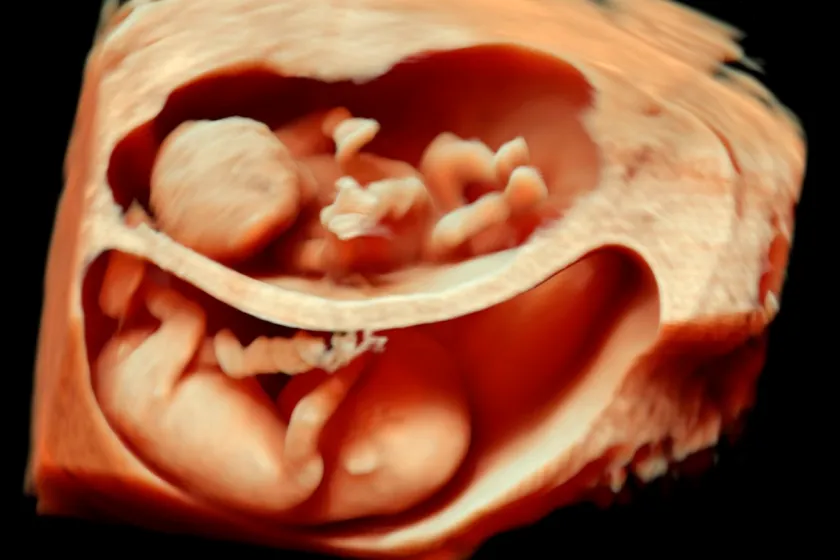
Carrying identical twins always brings special feelings and wonder, but our bodies sometimes hide very strange medical secrets. In extremely rare cases, a baby can develop malignant tumours while still in the womb. Such tragedies have puzzled doctors: does each baby develop the disease on its own, or can it cross from one twin to the other? We do not yet know all the secrets of unborn babies, but a new study has described a very rare case of cancer cells passing between twin sisters in the womb, and it has changed an old idea about how twins split.
The study was carried out by Sam Behjati and colleagues at the Wellcome Sanger Institute in Cambridge, UK, and published in Nature Communications in 2026. The researchers studied identical twin girls, Amelia and Amaya, who were delivered by caesarean section at 34 weeks after an ultrasound scan found a mass on one twin's face. Both died shortly after birth from multiple tumours. To solve the puzzle, the team carried out whole-genome sequencing (reading the entire DNA code) on about 45 samples from the twins' organs, the placenta and the tumours after their deaths. They used the small mutations that build up naturally over time to tell each sister's cells apart and to date when the disease began.
The analysis showed that a faulty fusion between two genes, MN1 and ZNF341, occurred in the first twin (twin A) at around the end of the first trimester. It led to a soft tissue sarcoma in her face, brain and liver. This is a rare tumour that affects the skin, nerves, blood vessels, muscles and fat. At around the end of the second trimester, a single tumour cell travelled from twin A to her sister (twin B) through the blood vessels they shared in the placenta, and multiplied to form tumours in her brain and skin.
The analysis also revealed a striking biological surprise about how the twins split after fertilisation. Instead of the early embryo dividing into two equal halves, as was always believed, just one cell broke away to form twin A, while the rest of the embryo's cells formed twin B and the whole placenta.
The findings show how tumours in unborn babies can travel through the shared circulation of the placenta, and they open a new line of research into the biology of twins and exactly how they split. The researchers stress that cancers like this are exceptionally rare in newborns and are not a normal risk of a twin pregnancy, and scientists are still learning why sudden mutations happen while the embryo forms. The most important step a mother expecting twins can take is to keep to her schedule of regular ultrasound scans with her doctor to follow the babies' growth and the health of the placenta.

Like

Love

Angry

Dislike