Ammi belongs to the carrot family (Umbelliferae), with flowers arranged in umbrella-shaped clusters, five-part flowers and secretory canals that give these plants their typical smell. It prefers sandy clay soils and grows across the Mediterranean, North Africa and western Asia, where it can be sown between April and July. Like the carrot, it is an annual with a taproot. There are two species:
Ammi majus (bishop's weed)
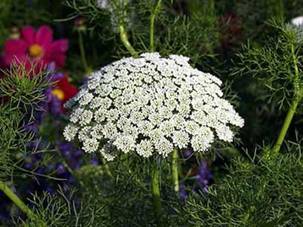
A slender, yellowish-green, finely grooved stem 30–100 cm tall. The lower leaves are divided once into oval leaflets, the upper leaves three times into narrow, toothed leaflets. The flower clusters have relatively few, widely spaced, upright stalks, which stay that way after flowering and fruiting.
Ammi visnaga (khella, toothpick weed)
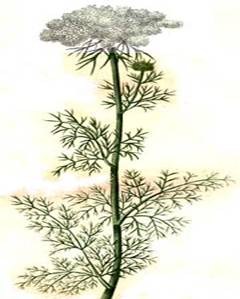
A thicker, bluish-green stem 20–80 cm tall with clear grooves, and leaves divided two or three times into narrow segments. The dense flower clusters have many thick stalks; when the fruit ripens in dry weather they draw together into a dense nest-like shape, and spread apart again in damp weather.
In both species the fruit is a small, oval, ribbed double seed, and resin canals in the root, stem and fruit give the plant its aromatic smell.
Traditional uses
The aromatic seeds of Ammi majus have traditionally been used as a tonic, to aid digestion, increase urine and relieve wind, colic and cramps. They contain psoralens (such as methoxsalen), which are the basis of medicines used under medical supervision with UV light (PUVA) to treat vitiligo and psoriasis.
The fruits of Ammi visnaga have traditionally been used to stimulate appetite, increase urine and relieve wind, and in Arab medicine for absent periods and kidney stones. Externally they have been used for rheumatism, gum inflammation and tooth decay, and in Spain the fragrant flower stalks are used as toothpicks. The plant contains khellin and visnagin, which relax smooth muscle; khellin was once used for angina and asthma before safer medicines replaced it.
Caution: Ammi majus makes the skin extremely sensitive to sunlight and can cause severe burns and blistering, and khellin from Ammi visnaga can damage the liver and cause nausea and dizziness. Neither should be taken without medical supervision, and they must be avoided in pregnancy. Kidney stones need a doctor's care.
By Dr Elias Jabbour

Like

Love

Angry

Dislike