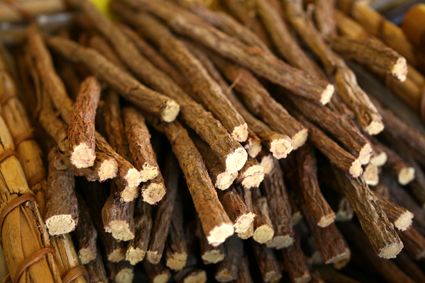
In the Middle East, a cold licorice root drink is a favourite way to quench thirst after a long day of fasting in Ramadan, yet few people know the plant's medical properties. Licorice, whose name comes from the Greek for "sweet root", is a perennial shrub up to two metres tall with dark leaves and pale yellow flowers. It grows wild in warm regions below 1,000 metres, in places such as Syria, Egypt, Asia Minor, Central Asia and Europe, and today it is cultivated widely.
It belongs to the same plant family as broad beans, beans, peas and chickpeas.
Scientific name: Glycyrrhiza glabra (tribe Galegeae, genus Glycyrrhiza, species glabra). The parts used are the roots and the rhizome.
Licorice in ancient medicine
Ancient civilisations knew this plant well, and it appears in many old texts. The Egyptians valued it highly: licorice was found in 1923 in the tomb of King Tutankhamun, and they made a drink from its roots. Ancient Egyptian doctors mixed it into bitter medicines to hide their taste, because licorice is 50 times sweeter than sugar, and they used it to treat liver and bowel diseases. It works well for many digestive complaints and is very effective against stomach ulcers.
The Babylonians used the roots more than four thousand years ago as a tonic for the body and its defences. The Greek physician Theocritus treated dry cough, asthma and severe thirst with it, and a fermented infusion was used for vomiting and stomach irritation.
Arab physicians used licorice both as food and as medicine. Avicenna wrote in his Canon of Medicine that its juice helps wounds, soothes and clears the windpipe, benefits the lungs and throat, clears the voice, quenches thirst, and helps inflammation of the stomach and bowels and burning urine. Ibn al-Baitar wrote that the most useful part of the plant is the juice of its root, sweet with a slight astringency. Placed under the tongue it eases roughness of the throat; drunk, it calms the stomach and bowels, chest pains, and complaints of the liver, bladder and kidneys; and chewed, it helps the stomach, coughs and phlegm.
Active substances and medical uses
Between 1955 and 1960, a steroid-like compound called glycyrrhizic acid was isolated from licorice roots. Its chemical structure resembles cortisone, but it was thought to lack the well-known side effects of long-term cortisone treatment.
Licorice also contains sugars and minerals, chiefly potassium, calcium, magnesium and phosphorus, as well as saponins, which make its juice foam when poured.
In the 1970s the drug Tagamet, containing cimetidine, came out, and several studies compared it with licorice extract. Cimetidine was better at healing stomach ulcers, but licorice extract gave better protection against duodenal ulcers coming back. Scientists then removed 97% of the glycyrrhizic acid to make deglycyrrhizinated licorice (DGL), which healed ulcers faster than cimetidine. Water retention remained the problem with licorice extract: licorice acts like the hormone aldosterone, made by the adrenal glands, which keeps water and salt in the body.
The roots contain nine compounds that help bring up phlegm and a tenth that counters toxins. A teaspoon of licorice powder is steeped in a cup of boiling water for five minutes, strained and drunk, up to three times a day. Long use or high doses cause problems such as headache, high blood pressure, fluid retention and low potassium. Thanks to glycyrrhizic acid, licorice also has anti-inflammatory effects on the joints. It contains natural plant oestrogens (phytoestrogens), which may ease menopause symptoms.
Studies in Japan in 1985 showed that glycyrrhizin, one of the components of licorice extract, is effective in treating cirrhosis and hepatitis, particularly hepatitis C. Japanese researchers also published work on its ability to slow liver cancer, and the Japanese health ministry went on to register a medicine based on it, Stronger Neo-Minophagen C.
Licorice also contains coumarins, triterpenoids and phenols:
- Coumarins, also found in parsley and citrus fruit, are natural blood thinners that help prevent clots in the heart (angina) and the brain (stroke).
- Triterpenoids, also found in citrus fruit, break down steroid hormones that help some cancers grow and slow the rapid cell division seen in tumours.
- Phenols, also found in fruit and vegetables, are plant substances (phytochemicals) that fight tumours and stop them growing.
Recent studies suggest the plant has some effect on the flu virus and on HIV, the virus that causes AIDS, and research into new medical uses of licorice continues.
Licorice should be used with caution by people with high blood pressure, because its extract raises blood pressure. It is also risky for pregnant and breastfeeding women and for people with diabetes.
By pharmacist Diana Arafa

Like

Love

Angry

Dislike