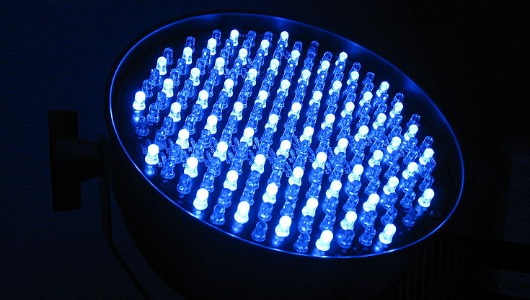
A light-emitting diode, or LED, is a light source made of semiconductor materials that gives off light when an electric current passes through it.
The first blue LEDs were invented in the early 1990s. Japanese scientists Isamu Akasaki and Hiroshi Amano and Japanese-American Shuji Nakamura created a new, efficient and environmentally friendly light source, the LED, and the Royal Swedish Academy of Sciences in Stockholm awarded them the 2014 Nobel Prize in Physics for developing efficient blue light-emitting diodes.
LEDs are among the most energy-saving lamps, and they are small, long-lasting and affordable.
They are most commonly blue, green and red, and combining the three colours produced a new generation of bright white lamps.
According to the website of the German doctors' newspaper Ärzte Zeitung, LEDs used to be found only in cars, but they are now everywhere in televisions, computer screens and smartphones, as well as in room and hall lighting.
How can they affect our sleep?
A recent British study noted that about 60% of people sleep less than seven hours a night, and LED lighting is one of the main reasons.
Health experts at Harvard Medical School, including sleep medicine professor Charles Czeisler, say that the strong glare from these artificial lights contains blue light waves. The cells of the retina are very sensitive to these waves and pass the signal quickly to the brain. The waves act much like caffeine: they stimulate nerve cells and centres, activate the nerves that keep us awake, and so upset the body's biological rhythm, causing sleep problems and mood swings.
The light also reduces the brain's release of melatonin, the so-called sleep hormone made by the pineal gland, which regulates the body clock by telling the brain it is time to sleep. Long exposure to these lights during the day, and especially in the evening when melatonin should be rising, tricks the brain into thinking it is still daytime. The body becomes more active and alert, causing severe insomnia.
In another study, published in the Proceedings of the National Academy of Sciences, Professor Anne-Marie Chang, who led the research, found that people who used tablets and e-readers before going to bed took longer to fall asleep. This was due to the short-wavelength light the devices give off, which cut their melatonin production by half, disturbed the body clock and upset their normal sleep pattern.
When this happens every day and we do not get enough sleep, it can lead to many health problems, such as obesity, diabetes, headaches, nervous strain, tiredness, heart disease, depression and poor concentration.
In children, besides the problems above, hyperactivity has been seen, caused by overstimulation and lack of sleep, which leads to poor attention and concentration. It may also affect long-term memory because the brain is overworked.
So avoid very bright lighting in the evening, and if you need it, dim the lights gradually. Avoid falling asleep in front of the television, do not use smartphones and tablets before going to bed, and limit electronic games, especially for children.
These findings have not yet been adopted by the World Health Organization or the US FDA, because the subject still needs more research.
By pharmacist Diana Arafa

Like

Love

Angry

Dislike