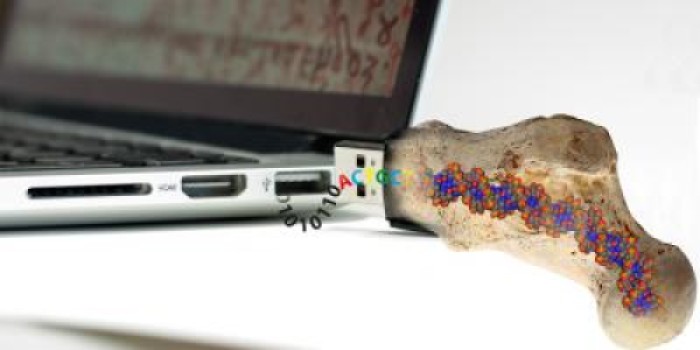
Scientists at ETH Zurich in Switzerland have stored computer data on DNA molecules so stably that it could last practically for ever.
Two years ago, scientists were already able to write information into a DNA molecule and read it back, and writing (making the DNA) and reading took very little time. But that fast method suffered from many errors in writing and reading. DNA reacts with chemicals in its surroundings, which changes the stored information and makes it impractical for keeping data for long periods.
Scientists in ETH Zurich's Department of Chemistry and Applied Biosciences took their inspiration from an old way of keeping information intact. Archaeologists and palaeontologists can extract DNA from the bones of animals that lived hundreds of thousands of years ago, because the spaces inside the bone keep the DNA away from damaging conditions.
So the scientists made spherical particles of silica (glass) 150 nanometres across and sealed the DNA with its information inside them. To test how well the information was kept, they put it through harsh conditions, raising the temperature to 60 to 70 °C for a month. This test is equivalent to the particles lasting hundreds of thousands of years. The results showed that the method keeps information for very long periods: DNA stored at -18 °C (in a freezer) would last about a million years!
The team also uses a clever method of correcting errors with complex algorithms.
Getting the data back out of the silica is the easy part, because the silica can be dissolved in a fluoride solution without harming the DNA.
The scientists are working on making the method cheap enough for general use and on improving its protection, especially against strong radiation such as on space missions and in communications technology. Who knows, the phone of the future may run on DNA.

Like

Love

Angry

Dislike