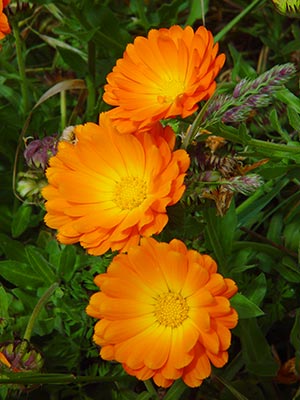
Latin name: Calendula officinalis, of the daisy family (Asteraceae). In Damascus it is called "zahrat al-gharib".
Widely grown in gardens and found in fields and orchards. Cultivated varieties grow 50 to 120 cm tall, with yellow or light orange flowers, single or double; the wild form is an annual up to 50 cm tall, with light orange flower heads from May to October. The stem is ribbed and sparsely branched, and the leaves smell rather like camphor.
Parts used
The petals, the flowering tops (July to September) and the leaves before flowering (May to June).
What it contains
The flower heads contain an essential oil with carotenoids (carotene, lycopene), resin, saponins, the bitter substance calendulin and salicylic acid.
Properties
Softens the skin, reduces inflammation, is antiseptic, eases spasms, helps regulate periods and heals burns.
Traditional uses
- Externally: calendula ointment for wounds, including slow-healing ones; a lotion or compress (100 g per litre of water) for impetigo, corns, calluses, warts, boils, mild burns, insect stings and chapped skin.
- Calendula oil: cover the yellow flowers with olive oil in a sealed bottle, leave in the sun for two weeks, shaking daily, then strain, squeezing the flowers through a cloth. It is massaged into the limbs for rheumatism and gout.
- Internally: an infusion (20 g per litre of water, up to 3 cups a day) for heavy or long periods, indigestion and stomach ulcers.
Caution: don't swallow essential oils or homemade oils. Other plants also called chrysanthemum contain thujone, which is toxic in large amounts. Avoid calendula in pregnancy.
Note: these are traditional uses, and most have not been proven by research. Talk to your doctor or pharmacist before using herbs as medicine, especially if you are pregnant or breastfeeding, have a long-term illness or take other medicines.
By Dr Elias Jabbour

Like

Love

Angry

Dislike