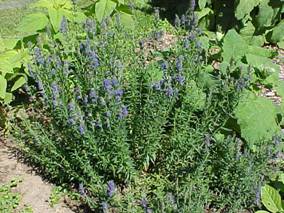
Hyssop (Hyssopus officinalis) belongs to the mint family (Labiatae). It is an aromatic herb native to the Mediterranean, common on sunny limestone ground. It grows 50–60 cm tall, with an upright, branching, square stem and narrow, stalkless leaves. Small blue-violet flowers, rarely white or red, open on one side of the flower head between June and August, and the fruit splits into four nutlets that ripen in August and September. It is grown from seed sown in March and only lightly covered with soil.
Dried hyssop is aromatic with a slightly bitter taste. It is used fresh or dried to season raw foods and salads (especially celery and tomato salads), and makes a good sauce for meat dishes, liver balls and potato soup. For immediate use, the young leaves and shoot tips are picked up to flowering; fresh hyssop is more fragrant than dried. For drying, the branches are cut just before flowering, tied in bunches and hung in the open air, and the dried leaves are kept in an airtight container so they don't lose their flavour.
Parts used
The whole herb, gathered while flowering and dried in the shade (the parts above ground).
Constituents
A volatile essential oil, tannins, the glycoside diosmin, resins, flavonoids and marrubiin.
Traditional uses
Hyssop is traditionally said to ease congestion, relieve wind and help wounds heal when used on the skin, and has been used for circulation problems, fever and gout.
- External: a tincture or infusion of the herb is used as a compress for wounds and sores, and as a gargle for inflammation of the mouth and tonsils: steep 3 g of the dried herb in a glass of hot water, strain and use.
- Internal: the same infusion is used traditionally to stimulate appetite and loosen phlegm in coughs, chest complaints and hoarseness, for heavy sweating and loss of appetite, to aid digestion, increase urine and relieve wind.
Caution: hyssop essential oil contains pinocamphone, which can trigger seizures; it must never be taken by mouth, and hyssop should be avoided altogether by people with epilepsy, in pregnancy and by children. Hyssop doesn't replace medical treatment for chest infections, asthma or high blood pressure.
By Dr Elias Jabbour

Like

Love

Angry

Dislike