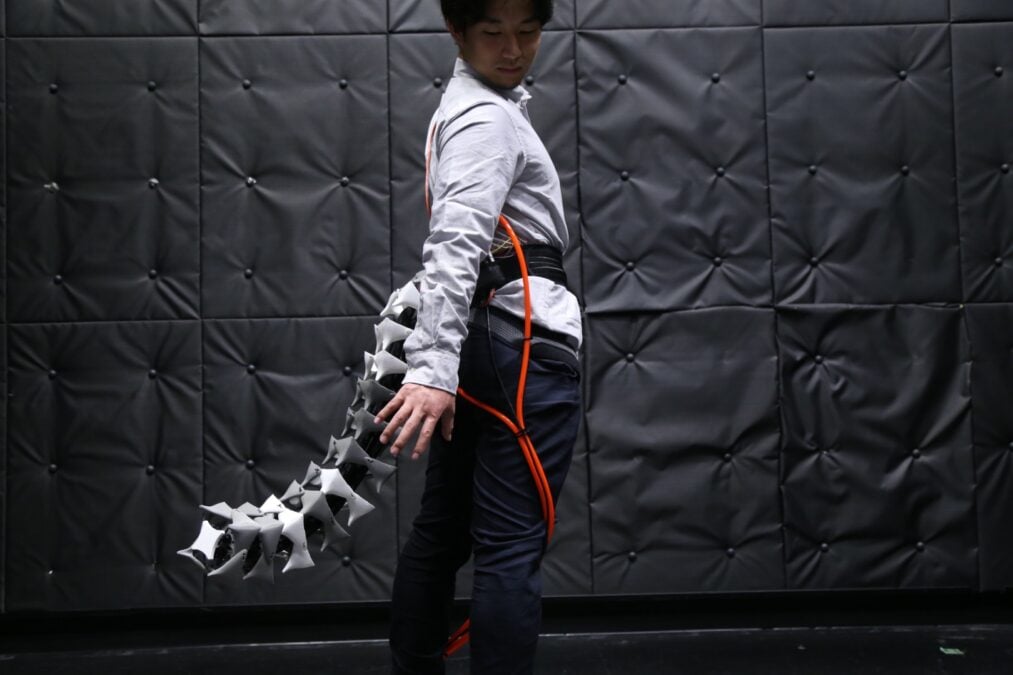
Many animals rely on their tails to stay balanced as they move and jump. Humans have no tail, so when we carry heavy loads we can struggle to keep our balance and may suddenly fall. A study shows that a wearable robotic tail can give the body its balance back.
Japanese researchers at Keio University's Graduate School of Media Design built a prototype robotic tail called Arque and published the details in ACM SIGGRAPH 2019 Posters. The device is strapped around the waist with a belt. In the tests it was between 71 cm and 1 metre long and weighed 1.6 kg. The tail is made of linked segments held together by elastic cords and springs, around inner parts whose weights can be adjusted. Four artificial muscles powered by compressed air move the segments.
The artificial muscles can move the tail in 8 different directions. The device senses how the upper body tilts, works out the user's centre of gravity and then swings the opposite way. The researchers based the joint design on a 2015 study in Science, which showed that the square structure of a seahorse's tail absorbs energy and withstands crushing and bending better than round structures. They also cited a 2016 study in the journal Primates showing that capuchin monkeys adjust their posture and use their tails for balance when they walk on two legs carrying heavy stone tools.
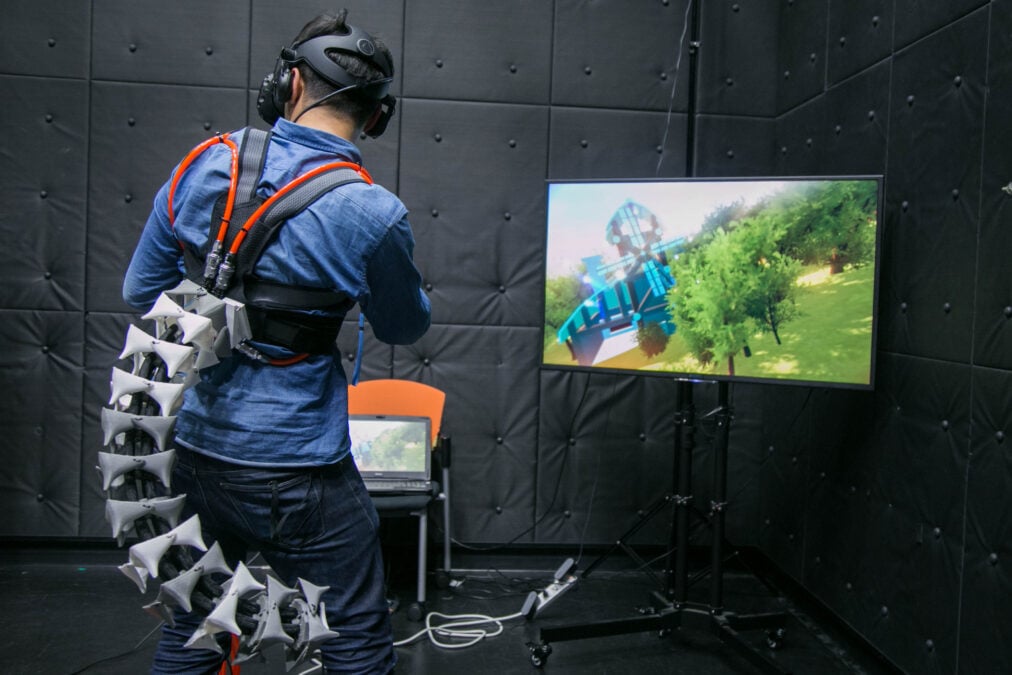
The aim is to help older people avoid falls and to support workers who carry heavy loads. The tail could also be used in virtual reality, pushing on the body to mimic a strong gust of wind. But the device still needs an external air pump to move.

Like

Love

Angry

Dislike