Latin name: Apium graveolens, of the carrot family (Apiaceae)
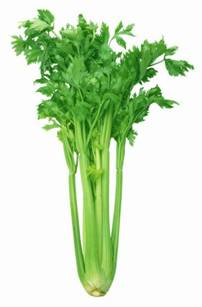
A biennial (sometimes perennial) cultivated herb, 50 to 100 cm tall. In its first year it forms a rosette of leaves 30 to 50 cm tall; in the second it sends up a flowering stem up to 1 m. The leaves are toothed and divided like feathers; the stem is upright, grooved and much branched, ending in umbrella-shaped clusters of small greenish-white flowers. The root is round, about the size of a fist, and the fruits are round and greyish-brown. All parts are aromatic; the leaf stalks and roots are eaten raw or cooked, and the leaves have a strong, slightly sweet aroma.
Parts used
The whole plant gathered at flowering, the juice, the roots and the seeds.
What it contains
The leaves contain the flavonoid glycoside apiin and other compounds, vitamins A, B and C, an essential oil, mucilage and starch. Raw celery is about 95% water, with about 0.8% protein, 3.8% sugars, 1.5% fibre and 17 calories per 100 g. It is rich in potassium and also contains sodium, calcium, phosphorus and iron.
Uses
Celery is considered to lower blood pressure, relax muscles, improve appetite and help in arthritis and kidney complaints. It is an antioxidant, mildly calming, and helps the bowels. Being very low in calories, it is excellent in slimming diets. It is a diuretic, and its fibre helps a lazy bowel. The seeds are used for colds and indigestion.
- Eaten raw for rheumatism, gout and low mood.
- Juice of the leaves and roots, a spoonful three times a day, as a kidney tonic.
- Celery salad with grated apple is delicious and gives all its benefits.
- In salads, soups and pickles.
Old Arab doctors (al-Razi, Ibn al-Nafis, Ibn al-Baitar and al-Antaki) prescribed celery for wind, colic, asthma, shortness of breath and cough, jaundice and difficulty passing urine, and said it increases urine and periods and stirs desire.
Caution: celery is not for pregnant women: large amounts of apiin may cause miscarriage. People with a weak bowel or indigestion should avoid large amounts. Celery is high in oxalate, so people with kidney stones should check with their doctor.
Note: these are traditional uses, and most have not been proven by research. Talk to your doctor or pharmacist before using herbs as medicine, especially if you are pregnant or breastfeeding, have a long-term illness or take other medicines.
By Dr Elias Jabbour

Like

Love

Angry

Dislike