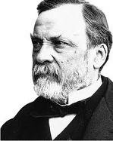
Louis Pasteur was a microbiologist and chemist best known for experiments proving that microorganisms cause disease, and for vaccines. He also made a great discovery in chemistry about the symmetry of molecules and how it relates to the way they turn polarised light. He helped solve the problems of silkworm disease and chicken cholera, and he invented pasteurisation of milk: the word "pasteurised" still appears on milk cartons today.
Not long ago, diseases were a mystery. There was a time when people had never heard of germs, and even doctors did not understand how diseases passed from one person to another. That was the situation in Europe throughout the nineteenth century.
Because people did not know what caused disease, they came up with explanations that were imaginative rather than scientific. Some believed that diseases, like small creatures such as lice, larvae and beetles, could arise spontaneously from the air. Pasteur said: "I was a man of science, and I proved beyond doubt that small creatures called germs cause some diseases."
Louis Pasteur was born in 1822 in the small town of Dole in eastern France. His father was a tanner who wanted his son to be educated, and sent him to Paris after secondary school in Arbois to study at a teachers' college. Illness stopped him continuing, and after he recovered his father sent him to the Royal College, where he graduated in 1840 with a degree in letters while also studying mathematics. Two years later he gained a degree in science, which he loved, although he did not excel in chemistry, the field in which he was determined to make his name. His teachers realised he was no ordinary student: he was meticulous and thorough and insisted on doing things precisely.
Pasteur turned to the study of fermentation and found that it was caused by tiny microorganisms, which were also responsible for spoiling fermented drinks. He quickly reached another conclusion: such organisms could harm people and animals. He was not the first to suggest this, but he was the first to prove it by scientific experiment, and that alone convinced the scientists of his time.
If germs cause disease, then destroying or blocking them would prevent or reduce disease, so he was the first to call for antiseptics to protect people from infection. This led another scientist, Joseph Lister, to use antiseptics in surgery.
In his fifties, Pasteur turned to anthrax, a serious disease of humans and animals. He found that a particular bacterium caused it, and he managed to produce weakened forms of the bacillus. Injected into animals, these caused a milder illness that did not kill them and gave them immunity against the disease. The discovery shook the scientific world, and doctors realised that Pasteur's method could prevent many other diseases. Pasteur also vaccinated people against rabies, first trying the vaccine on a boy from Alsace, Joseph Meister, in 1885. Other doctors used his method to make vaccines against many other serious diseases, such as typhoid.
Pasteur worked tirelessly, and his patience and persistence led to many discoveries in medicine. He also found that some organisms can live without air or oxygen, the anaerobic bacteria. His research on silkworms had huge economic results, and his great discoveries included a vaccine against chicken cholera.
Paul Bert summed up Pasteur's work on fermentation and germs in three points:
- Every fermentation is produced by a particular microbe.
- Every infectious disease is caused by the growth of a microbe in the body.
- A microbe grown under special conditions is weakened and becomes a vaccine.
Pasteur died in 1895, aged 72, leaving the mark of a scientist who improved the health of millions.
Pasteur's father used to come home at night from his exhausting work, sit his son on his knee and say: "Ah, Louis, how happy I would be if you became a teacher. I work all day with these stinking hides, tanning them into leather. I have had many hard years, and I want your life to be easier than mine. My son, you must learn." Louis was only two, and his mother would say: "Yes, our son must learn." But they could not see the great man he was destined to become. Had they been able to look sixty years ahead, they would have seen a plaque on the door of their house, written in golden letters: "Here Louis Pasteur was born on 27 December 1822."
Pasteur is buried in Paris, in a crypt at the Pasteur Institute.

Like

Love

Angry

Dislike