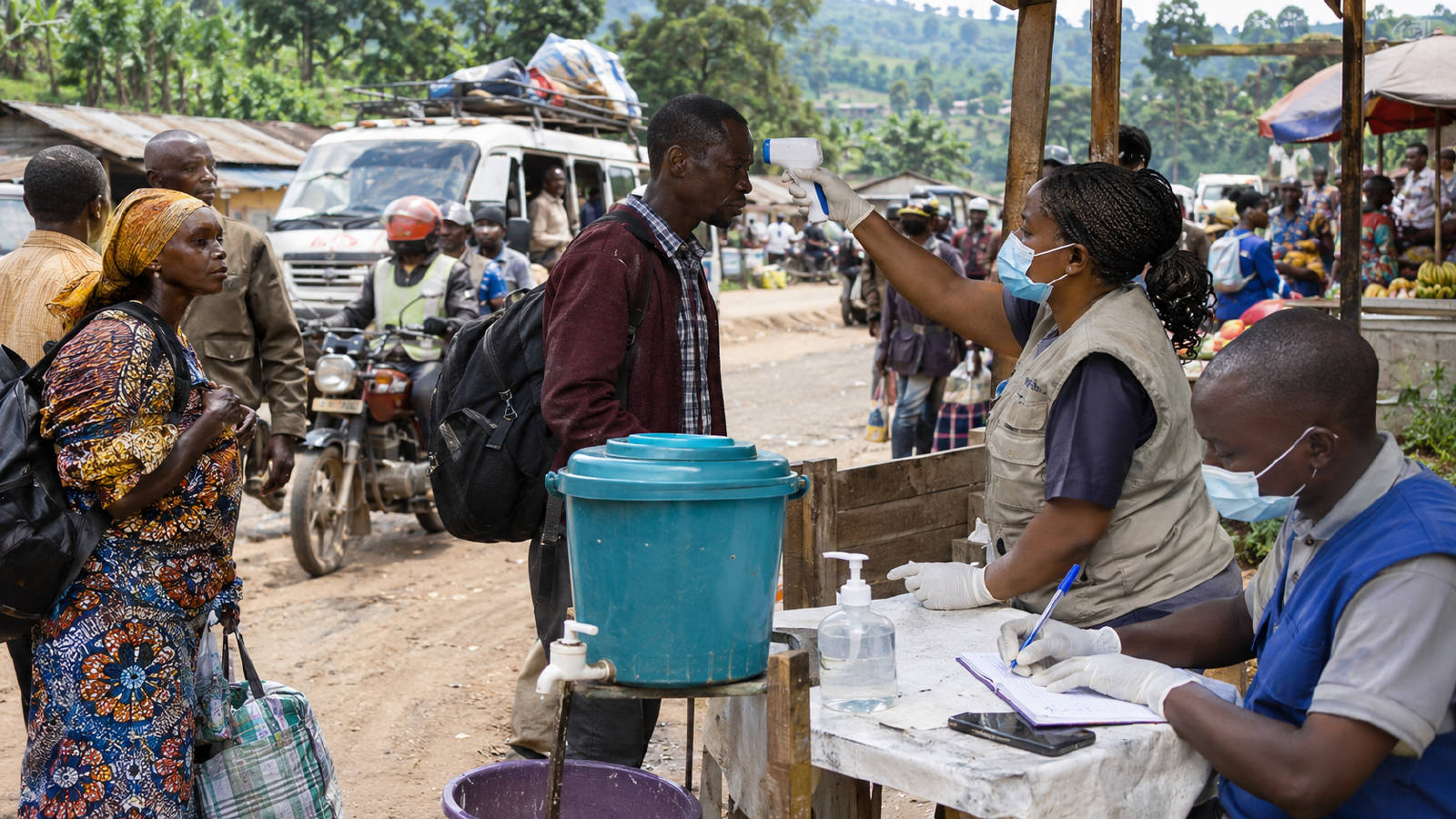
The International Organisation for Migration (IOM) has announced the detection of 71 confirmed cases of Ebola along transport routes in the Democratic Republic of the Congo since the outbreak began some six months ago. Of particular concern is that 95 per cent of these cases were detected on informal routes. These are routes used by people to travel away from authorised crossing points and checkpoints. This demonstrates that official border controls alone are not sufficient to monitor the spread of the disease.
In a report published by the United Nations on 10 November 2026, Dr Andrew Mbala, Regional Coordinator for Ebola Response at the International Organisation for Migration, said: “The response to the epidemic must not be limited to hospitals, treatment centres and isolation facilities. It must also include monitoring population movements. To this end, the organisation is mapping markets, bus stations and places of worship, and identifying the routes people take between different areas, particularly those where the disease is spreading.”
According to the World Health Organisation (WHO), more than 10,400 confirmed cases and 5,103 deaths had been recorded in the Democratic Republic of the Congo as of 31 October. Surveillance teams have carried out 55 million Ebola virus tests since the start of the outbreak in the Democratic Republic of the Congo and 11 neighbouring countries. The report also revealed that most people transporting the bodies of those who have died from Ebola use methods that are not subject to official monitoring (smuggling). Surveillance teams intercepted 258 such body transfers. Monitoring these movements is particularly important because the transport of bodies outside controlled channels makes it more difficult to track the spread of the infection.
The International Organisation for Migration supports health surveillance at 57 sites for displaced people within the Democratic Republic of the Congo. Fifty of these are located in health zones affected by the outbreak. It is also helping affected and at-risk countries to improve the early detection of cases. However, ongoing transmission and population movements pose significant challenges to these efforts, particularly given the lack of funding. The organisation requires $110 million for its regional operations until March 2027, whilst it is currently short of approximately $60 million. These figures underscore the importance of monitoring the movement of people outside official crossing points. However, they do not specify the number of cases that remain undetected, nor the extent of the disease’s spread along routes not reached by surveillance teams.

Like

Love

Angry

Dislike