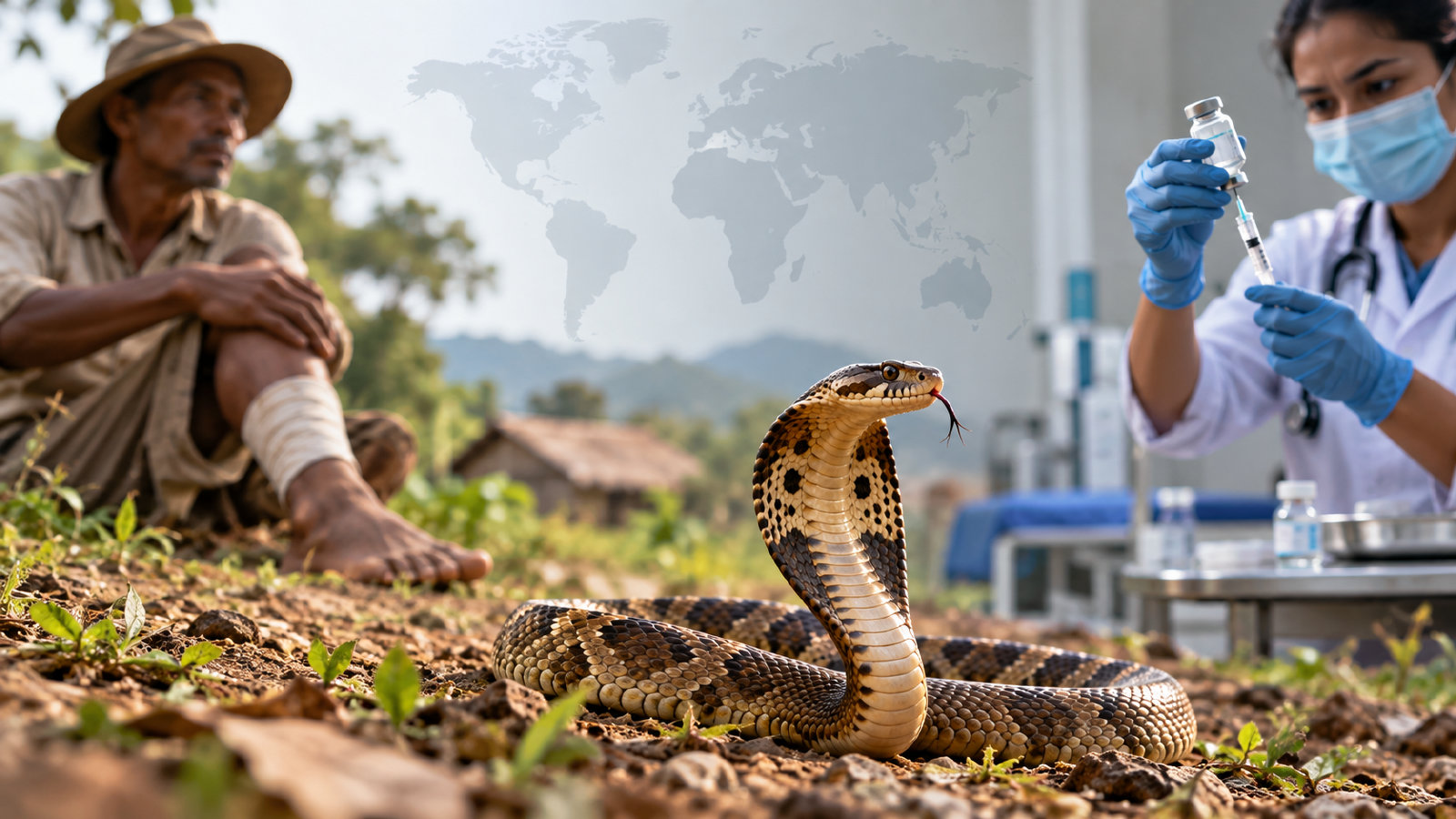
Most people poisoned by snakebites live in poor, remote countryside without even basic clinics. For decades the official figures did not reflect reality, because more than half of the countries at risk do not record these cases. A new study reveals alarming numbers, far higher than international health records suggest.
The study was led by the Liverpool School of Tropical Medicine in the UK, together with researchers who specialise in tropical disease epidemiology. The team analysed data from 79 countries, reviewing studies published up to 31 March 2025, to update their landmark 2008 study. Many rural parts of Africa and Asia keep no official records, so the researchers built a geostatistical model: a mathematical method that estimates what cannot be seen by combining known data with environmental signals. They fed the model detailed information on climate, the variety of venomous snakes and social and economic indicators, and compared hospital data with local field surveys to estimate how many cases go unrecorded.
The results show that between 2.1 million and 7 million people are poisoned by snakebites every year worldwide, and that these bites kill between 274,000 and 513,000 people a year. The researchers also found that more than 800,000 people a year are left with permanent disabilities, such as amputated limbs. Most cases occur in sub-Saharan Africa, in countries such as Nigeria, the Congo and Ethiopia. The heavy toll comes from the many highly venomous snakes in these regions, such as cobras and mambas. It is made worse by farmers working without shoes, walking at night on unlit paths, hospitals far away and a shortage of antivenom.
The study stresses that missing data hid, for many years, a health crisis that needs urgent international action. The models have drawn a rough map of the forgotten areas, but they remain estimates that must be completed with ongoing surveys on the ground. The hope is that governments and global health bodies will use these data to supply antivenom and train health workers in remote villages.

Like

Love

Angry

Dislike