A great mimicker with many clinical faces: 12 years' experience from Aleppo. For a dermatologist in Aleppo, every skin lesion is leishmaniasis until proven otherwise.
The study was carried out at the Specialised Centre for Skin Diseases in Hamdaniyeh, Aleppo, from 1997 to 2009. It covered 6,200 cases of cutaneous leishmaniasis, an average of 500 a year. The parasite found in Aleppo is Leishmania tropica.
Definition: a chronic case is any case that has not healed after a year, whether treated or not. There were 1,880 chronic cases; the diagnosis was confirmed in about 1,750 and remained unconfirmed in about 130.
Diagnosis
- Clinical: the shape and site of the lesions, together with the epidemiological history (where the patient lives, similar lesions in family members).
- A positive smear, taken at the first visit to a health centre.
- Skin biopsy, with standard or Giemsa staining.
- Improvement of the lesions during treatment, or temporary healing lasting from weeks to months in relapsing cases.
- Culture and PCR were not available.
Aims of the study
- To identify the clinical forms of chronic cutaneous leishmaniasis and the share of each.
- To identify the age group in which chronic cases are most common.
- To identify the suspected causes of chronic disease.
- To develop a new treatment plan to curb the rise in chronic cases.
No attempt to control the disease can succeed without controlling the chronic cases.
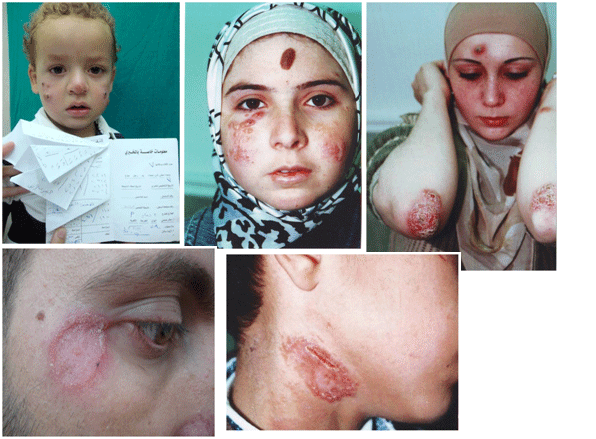
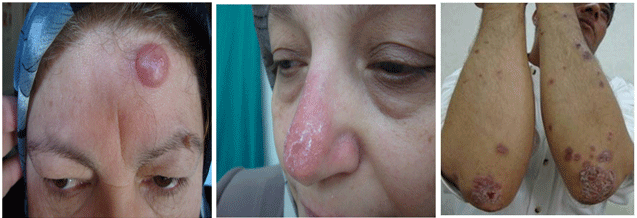
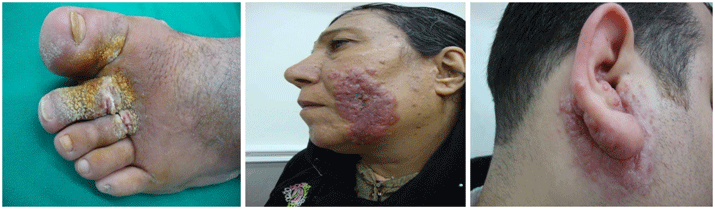
Main clinical forms of chronic disease
- Papulonodular: 40.3%
- Plaque: 37.1%
- Annular (ring-shaped): 13.4%
- Tumour-like: 4.6%
- Wart-like (verrucous): 1.4%
- Ulcerative: 1.25%
- Rosacea-like: 1.1%
- Sporotrichoid: 0.47%
Main findings
- Papulonodular and plaque forms together made up about 77.4% of cases, annular forms 13.4% and other forms 9.2%.
- 80.6% of patients were children under 16.
- The face was affected in 88.6% of cases.
- In 1,325 of the 1,750 cases (75.9%), the lesions were on the faces of children.
Causes of chronic or relapsing disease
The real causes are unknown, but suspects include:
- Resistance to treatment.
- Poor management: with injections into muscle, too little medicine or too short a course; with injections into the lesion, too little medicine per lesion, poorly chosen injection sites, or injecting too deep, under the skin.
- The patient's own immune factors.
- Other factors: other skin diseases (atopic eczema, psoriasis, varicose veins in the legs); work and injuries (wart-like and ulcerative forms); sun exposure (rosacea-like forms); pregnancy (tumour-like forms); previous treatments (triamcinolone injections, liquid nitrogen); and other illnesses (anaemia, diabetes, immunosuppressive drugs).
Recommendations
- All dermatologists should take part in diagnosis, treatment and follow-up.
- Better diagnosis, by making PCR available.
- Changes to treatment plans, with antimony compounds still the mainstay: more use of combined antimony treatment (injections into the skin and into muscle) for patients at high risk of chronic disease; combinations, such as antifungals like itraconazole and fluconazole, for cases that do not respond; and access to drugs such as amphotericin, to which no resistance has been recorded, for stubborn cases.
- Much more research into both treatment and prevention, especially as Aleppo is one of the four cities in the world with the most cases.
Dr Majd al-Din Douba, Specialised Centre for Skin Diseases, Hamdaniyeh, Aleppo

Like

Love

Angry

Dislike