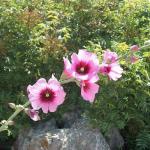
Hollyhock (Alcea rosea) belongs to the mallow family (Malvaceae). It is a herb that grows into a perennial, reaching up to 3 m, with an upright, branching stem covered in rough hairs, and alternate, rounded, hand-shaped leaves with toothed edges. Clusters of flowers grow from the leaf joints between June and September, in purple or pink (often white in the related marshmallow, Althaea officinalis). The fruit splits into 15–20 nut-like segments with kidney-shaped seeds.
Parts used
The dried petals and flowers, the leaves and the roots.
Constituents
The flowers are rich in mucilage (up to 35%), as well as starch, sugars, pectin, tannins, traces of essential oil, flavonoids, coumarins, asparagine and anthocyanin pigments (malvin, malvidin).
Traditional uses
Thanks to its mucilage, hollyhock is soothing: it is traditionally used to calm the airways and irritated skin, ease constipation, reduce fever and inflammation and promote sweating, and it has antioxidant properties.
- External: a decoction is used as warm compresses for skin inflammation, chapped fingers and chilblains, and in children's baths to soothe and soften the skin.
- Internal: a decoction of 2–3 teaspoons of dried flowers in a glass of water, strained, sweetened with sugar or honey and drunk hot in two doses, morning and evening, is used for bladder irritation, stomach and duodenal ulcers and digestive upsets. It is also combined with other chest herbs in "zahourat" blends for coughs, bronchitis and asthma, and as a mild laxative.
Caution: hollyhock is generally mild, but it doesn't replace treatment for ulcers, kidney or bladder infections, asthma or burns. Mucilage can slow the absorption of medicines, so take it a few hours apart from other medicines. Ask a doctor before using it in pregnancy or for young children.
By Dr Elias Jabbour

Like

Love

Angry

Dislike