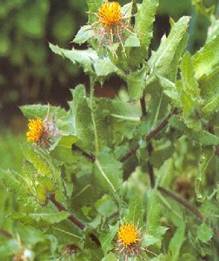
Latin name: Cnicus benedictus
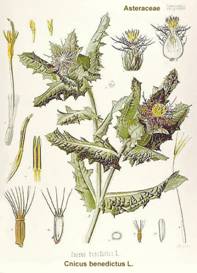
Found in fields, farms and meadows, this herb grows about 40 cm tall. Its long, stalkless leaves are toothed and spiny, covered with cobweb-like hairs, and its pale yellow flowers are almost round.
Parts used
The leaves (May to July), the flowering shoot tips (June and July) and the whole herb.
Active substances
Bitter substances, mucilage and tannins, which ease coughing up phlegm, help digestion and increase urine.
Traditional uses
- Externally: the juice, or compresses of a decoction, for burns, sores and frostbitten toes.
- Internally: an infusion as a tonic during recovery from illness, and for indigestion and liver complaints. Use 1 teaspoon of dried herb per cup of boiling water; 1 to 2 cups a day, half an hour before meals.
Caution: too much causes vomiting. Stomach ulcers need a doctor.
Note: these are traditional uses, and most have not been proven by research. Talk to your doctor or pharmacist before using herbs as medicine, especially if you are pregnant or breastfeeding, have a long-term illness or take other medicines.
By Dr Elias Jabbour
0

Like
0

Love
0

Angry
0

Dislike
0