Latin name: Crocus sativus, of the iris family (Iridaceae)
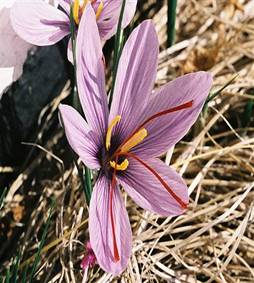
A slow-growing perennial bulb plant, 30 to 50 cm tall, with small corms and narrow green leaves. It flowers in autumn (September to December), producing a few violet flowers. Each flower has a long, thread-like pale yellow style ending in a three-lobed, reddish-purple stigma. The stigmas are the main crop of saffron, giving the precious dye crocin. To get 1 kg of dry stigmas, you need the flowers of about 10,000 plants.
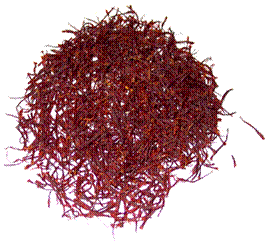
Its root is a scaly bulb, its leaves green and its flowers blue-violet; the flowers close at night. Only the stigmas are used medicinally.
What it contains
Saffron stigmas contain crocin, the yellow dye: 1 g dissolved in a litre of water turns it clearly yellow. They also contain picrocrocin, which splits into a sugar and a volatile oil that gives saffron its characteristic taste and smell, as well as a fixed oil (8–13%), a volatile oil (1.3%), starch and lycopene.
Traditional uses
- Said to brighten the eyes, stimulate the stomach, strengthen the heart and ease spasms.
- Taken with honey, it was believed to break up stones.
- Dissolved in vinegar and rubbed on the temples, it was used to ease a severe headache.
- The stigmas were considered refreshing and an aphrodisiac for men.
- Used as a tonic, a gentle nerve stimulant, against colds and against pain from inflamed mucous membranes.
- Used for asthma, as a pain reliever and stomach tonic, to relieve colic, and to bring on periods (so it should be avoided in pregnancy).
Saffron is widely used as a colouring in the food industry, where it also adds a pleasant taste and smell, and it is an ingredient in many pharmaceutical preparations.
By Dr Elias Jabbour

Like

Love

Angry

Dislike