Latin name: Origanum majorana, of the mint family (Lamiaceae)
A perennial herb 30 to 60 cm tall, growing in moist and semi-dry mountain land. It is native to North Africa and southern Europe and is now grown in most warm and temperate places. It grows on sunny slopes, in meadows and fields and on stony ground in dry climates.
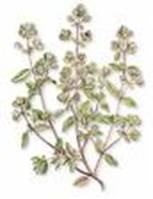
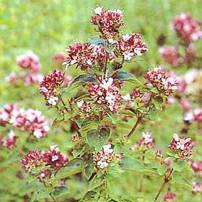
It has creeping roots and a hard, ribbed, much-branched stem, dark at the base and reddish-brown at the top, covered with fine hairs. The leaves are tongue-shaped, and the stalkless pink or purple flowers form spike-like clusters. The herb has a light, pleasant scent and flowers in August and September.
Parts used
The leaves, once fully dried, and the spike-like flowers.
What it contains
The upper part of the plant contains aromatic oils with phenols (thymol and carvacrol), tannins, a bitter substance and vitamin C, which reaches 166 mg per 100 g in the flowers. The seeds contain a fatty oil.
Properties
Traditionally considered pain-relieving, antiseptic and antispasmodic, and said to lower blood pressure and help sleep.
Medical uses
Internally: an infusion of the leaves is used for bronchitis and asthma, and the oil distilled from the plant for rheumatic swelling of the joints. An infusion is also used as a calming drink, to settle the stomach and to increase urine, and a decoction to regulate periods (so it is not for pregnant women). Dried marjoram leaves are used in many preserved foods, to season meat and in place of ordinary tea.
Externally: the oil is used to relieve pain in children's ointments, and the whole plant in children's baths to soothe the skin. It calms the nerves, and compresses on the nose ease a cold.
By Dr Elias Jabbour

Like

Love

Angry

Dislike