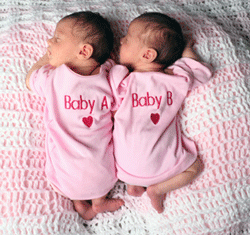
1. Twins and superstition
Twins have always attracted more attention than other babies, and in some cultures they are viewed strangely: the mother of twins may be shunned or revered. In parts of India she was once considered unchaste, because a man was thought unable to father more than one child at a time. Some tribes in southern Africa cut off one of the father's testicles so that twins would not be born again. In some parts of the world one twin was killed, or twins were feared for supposed supernatural powers, such as winning wars or bringing rain. In Guinea, twin pregnancy was blamed on the mother eating two bananas joined together from the same bunch. Among the Baganda people of Central Africa, parents of twins were thought so fertile that they could increase the harvest. In New Guinea, a twin whose sibling died was held sacred, kept from certain foods and decorated with white beads.
2. Some famous twins
- Castor and Pollux: heroes of Greek mythology, sons of Zeus, king of the gods, and Leda, and brothers of Helen, over whom the Trojan War was fought.
- Esau and Jacob: the sons of Isaac and Rebecca. Jacob was the father of twelve sons, one of whom was Joseph.
- Romulus and Remus: the founders of Rome in Roman mythology.
- Viola and Sebastian: the twins of Shakespeare's Twelfth Night.
3. How common are twins, and why?
In Britain, about 1 in 87 births are twins, 1 in 87² triplets and 1 in 87³ quadruplets. These figures change for various reasons, including fertility drugs that stimulate ovulation. Geographically, multiple pregnancies are more common in Nigeria (about 10.1%); ethnically, non-identical twins are more common in Black populations and less common in Japan. Identical twins occur at a steady rate of about 3 in 1,000 everywhere.
Non-identical twins become more likely after the second pregnancy, with an older mother, in poorer families, and with a family history of twins, which is thought to be inherited through a recessive trait. They are also more likely after stopping the pill when it has been taken for more than six months. Conjoined twins are more common in southern Africa.
4. Identical and non-identical twins
- Identical twins are of the same sex (with very rare exceptions) and look the same: the same hair curl and texture, skin and eye colour, fingerprints, tooth shapes, iris patterns and ear shape, and very similar weight and height. Two thirds of identical twins share the same chorion (outer membrane) and blood groups.
- A single placenta is not always proof of identical twins: more than 75% of twins with a fused placenta and two chorions are non-identical.
- Triplets can come from one, two or three eggs.
- Twins of different sexes almost always come from two eggs, while a single chorion almost always means one egg, regardless of the amnion.
- It is wrong to assume that same-sex twins with one placenta come from a single fertilised egg. HLA tissue typing has shown that twins, even of the same sex, can occasionally have different fathers (two ovulations).
5. Birth weight and length of pregnancy
- Twins: average birth weight 2,395 g, average pregnancy 262 days.
- Triplets: average birth weight 1,818 g, average pregnancy 247 days.
- Quadruplets: average birth weight 1,395 g, average pregnancy 237 days.
6. Problems in pregnancy and birth
Twin pregnancies and births have higher rates of:
- Deaths around birth: eight times higher for identical twins than for single babies, and four times higher than for non-identical twins.
- Excess amniotic fluid (polyhydramnios).
- Pre-eclampsia and a low-lying placenta.
- Bleeding before birth.
- Cord prolapse.
- Premature labour.
- Weak contractions.
- Birth defects, especially in twins sharing one chorion.
- Abnormal presentation: both head-first in 47%, one breech in 37%, both breech in 8%.
- Twin-to-twin transfusion syndrome, which leaves one twin with too much blood and the other anaemic. The smaller twin is usually the donor, and the larger one is prone to jaundice.
Identical twins are also born earlier on average than non-identical twins, and low blood sugar in the newborn is more likely the smaller the baby.
7. Family problems and outlook after birth
- Parents of a large family age faster and are more tired.
- Bonding between mother and twins can be harder, especially if one is in hospital and the other at home.
- It is hard to find enough time to care for both.
- Twins have a slightly lower average IQ and a higher rate of cerebral palsy: of 651 people with cerebral palsy, 8.4% were twins, and of 729 people with intellectual disability, 3.8% were twins.
- The lower the birth weight, the higher the risk of cerebral palsy. If one twin has cerebral palsy, there is a one in two chance that the other has died; if it survives, it is often unwell in its first three years.
- Language delay is common in twins, especially the younger one, whose speech may be unclear and late.
- Authors disagree about lower IQ in twins, especially on verbal tests, but on the whole twins score a little below average. This cannot be explained by the mother's age, birth order, family size or income, birth weight or length of pregnancy, and is probably due more to circumstances after birth than before.
- Twins' late speech may be because they develop their own private language, living together and talking less with other children, who learn from adults; and a mother busy with one twin has less time for the other.
- Left-handedness and stammering are more common.
8. Diseases and problems
The smaller twin usually stays smaller throughout childhood. If one twin has one of the following conditions, the other is also at risk:
- Heart defects are five times more common in identical than in non-identical twins.
- Cleft lip, with or without cleft palate, is also more common.
- Wilms' tumour, medulloblastoma, retinoblastoma, leukaemia and Letterer–Siwe disease (a form of histiocytosis X) are also more common.
- Beal in Australia described the unexplained deaths of identical twins who died on the same night at five months old.
9. The mother's problems
While the father is (sometimes) delighted, the mother is (often) anxious during pregnancy, afraid at the birth and depressed afterwards, so much so that in some cultures women take out insurance against twins when they are diagnosed in pregnancy. The mother's main problems include:
- Feeding, washing, and feelings of guilt.
- One twin being naughty, whiny or slow and needing extra attention, making the other jealous.
- One twin going to hospital or being punished, which upsets the other twin and the mother.
- Jealousy between the twins: the mother need not always avoid it. Up to a point it is normal, and one can be given a present without the other being jealous, if they know their turn will come without favouritism.
- Practical problems: buying and selling twins' clothes, furniture and so on. Many specialists recommend giving each twin different types and colours of clothes and toys so that each has their own identity and belongings, whatever curious relatives may think.
- Feeding problems: deciding when and what to feed both when both scream with hunger, or one is hungry and the other asleep. When breastfeeding, feed both together from both breasts, switching breasts during the feed and starting the next feed with each baby on the other breast. Solid food can be given to both from one plate and spoon, except in special cases.
- Bath time: Mark Twain joked, "My twin and I got mixed up in the bath when we were two weeks old, and one of us drowned, but we never knew which."
10. Psychological problems
In psychological studies of twins, the effects of environment and heredity cannot be fully separated, but:
- Differences between twins come mainly from their parents' attitudes towards each of them and from circumstances after birth (environment), more than from before birth (heredity).
- Twins are prone to neurosis, usually anxiety, without personality disorder.
- There is no difference between identical and non-identical twins in behaviour problems and delinquency in adolescence, which points to the environment as the main cause, while some adult problems are more closely shared by identical twins, suggesting a genetic role.
- Schizophrenia is 42 times more common in identical twins than in the general population, but only 9 times more common in non-identical twins.
- Twins tend to be introverted, shy and fond of solitude, and fewer of them marry. Even so, they should be put in separate classes at school to reduce jealousy and rivalry. The first-born tends to be more mature, a leader, responsible and ambitious, while the second is more cheerful, carefree and gentle but also more stubborn.
Being a twin strengthens the bond between the twins but weakens each twin's bond with the parents. Parents should therefore take each twin out on their own, sometimes with the father and sometimes with the mother, so that they are treated as two separate people rather than one, while keeping the twin bond in mind, to support their individual differences later in life, in marriage, possessions and qualifications.
By Dr Mohammad Saad Shayeb, specialist in paediatrics and neonatology, lecturer at the University of Aleppo

Like

Love

Angry

Dislike