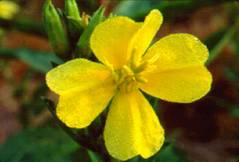
Oenothera is a genus of about 125 species of annual or biennial flowering herbs, native to North and South America. Their common names include evening primrose, suncups and sundrops.
They range from 10 cm to 3 m tall. The leaves form a rosette at the base and spiral up the stem. The flowers open in the evening, hence the name "evening primrose", and are usually yellow, sometimes white, red, purple or pink. Each flower has four petals, and the tip of the style has four branches forming an X. The flowers are pollinated by bees and by moths.
The common evening primrose, Oenothera biennis (oil: evening primrose oil, EPO), belongs to the family Onagraceae, order Myrtales.
The roots can be eaten as a vegetable and have a peppery taste. An infusion of the whole plant has traditionally been used as a painkiller and to stop bleeding, for coughs caused by asthma or whooping cough, and for digestive complaints.
The ripe seeds contain 7–10% gamma-linolenic acid (GLA), a rare omega-6 essential fatty acid. Essential fatty acids are part of every cell membrane and play a part in cell metabolism, in providing energy, in keeping the body warm, in insulating nerves and in protecting body tissues. The oil is pressed from the seeds and sold as capsules.
Evening primrose oil has been used since the 1930s for eczema, and later for rheumatism, breast pain linked with periods, menopausal symptoms, and as an add-on in cancer and diabetes. Most people tolerate it well; side effects include stomach upset and headache.
Update: a large review of trials found that evening primrose oil taken by mouth doesn't improve eczema, and good evidence for its other uses is lacking. It may increase the risk of bleeding with blood thinners, and should be used with care by people with epilepsy and in pregnancy.

Like

Love

Angry

Dislike