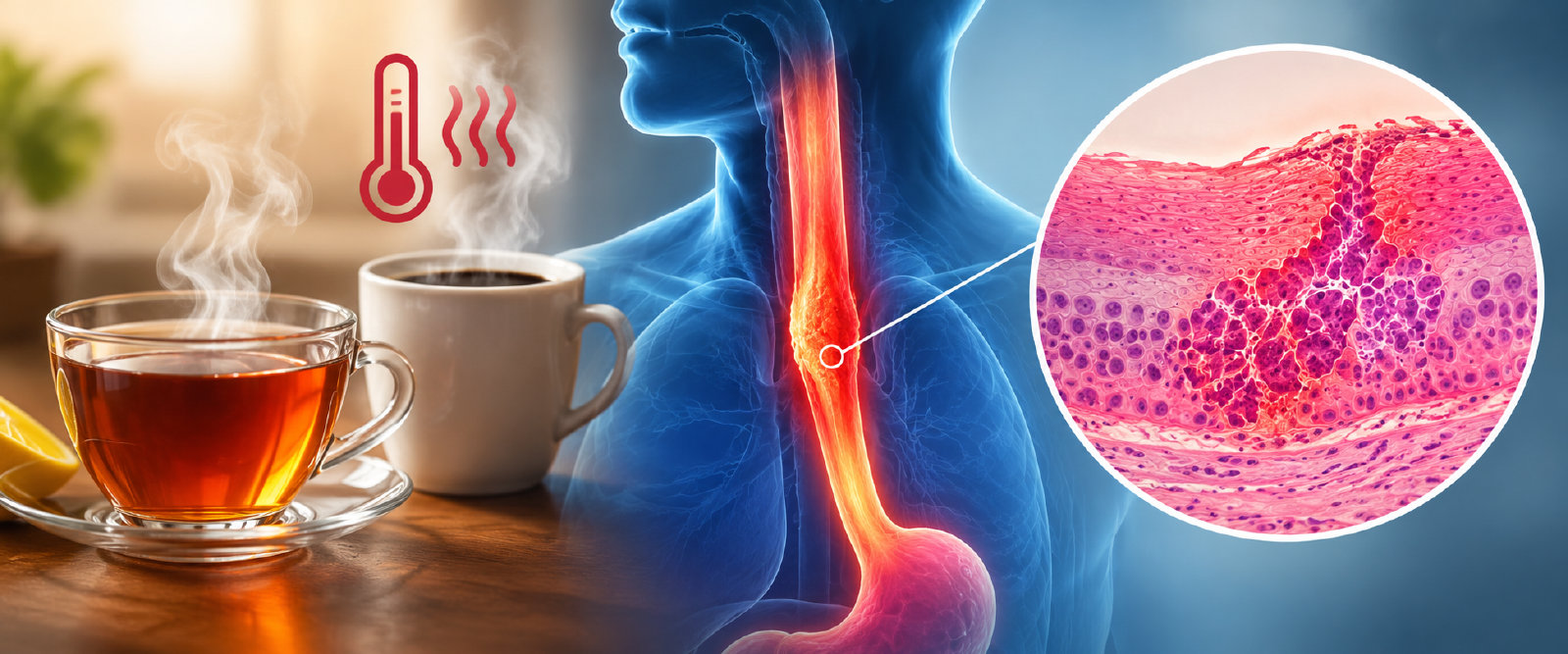
In 2016, the International Agency for Research on Cancer classified very hot drinks, above 65 °C, as probably carcinogenic to humans. That is the usual temperature of tea and mate in much of the Middle East, Asia, Africa and South America. But it was not clear whether the risk also applied to the temperatures at which tea and coffee are usually drunk in Europe and America.
Nutritional epidemiologist Keren Papier and colleagues at the University of Oxford analysed data from two huge British population studies, the Million Women Study and UK Biobank. The results, published in the International Journal of Cancer, cover 977,282 people, making it the largest study so far of hot drinks and oesophageal cancer. Participants answered questionnaires about how many cups of tea and coffee they drank a day and how hot they liked them: "very hot", "hot" or "warm".
People who liked their drinks "very hot" had 3.17 times the risk of a particular type of oesophageal cancer, squamous cell carcinoma (SCC), compared with those who drank them "warm". "Hot" drinks were linked to a 69 percent higher risk than warm ones, and the risk was 71 percent higher in people who drank six or more hot cups a day than in those who drank fewer. The risks were the same whether the drink was coffee or tea, and even when milk was added. The researchers explain this with earlier animal experiments showing that water at 70 °C causes heat injury that kills tissue and creates damage that encourages cancer. Repeated scalding weakens the lining of the oesophagus and sets off cancer-causing processes.
The study matters because it shows that the problem is the high temperature of the liquid, not what is in the tea or coffee. Its weakness is that it relies on what participants said, without measuring real temperatures, so we do not yet know the exact temperature at which the damage starts. Even so, the scientists estimate that simply letting a drink cool from "very hot" to "hot" could prevent 14 percent of cases of this type of oesophageal cancer, which could spare hundreds of people the disease every year.

Like

Love

Angry

Dislike