Latin name: Syzygium aromaticum
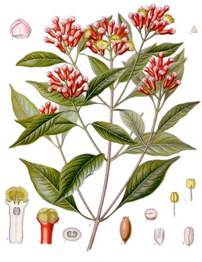
An evergreen tree up to 12 m tall, with oval leaves with smooth edges. The flowers grow in clusters and turn brown as they ripen; they are nail-shaped, with overlapping petals curled into a ball. The mature flower buds are the source of clove oil. It is native to hot regions, China and India.
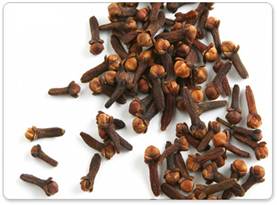
Parts used
The dried flowers and flower buds, and the essential oil.
What it contains
The main active substance is eugenol, along with eugenyl acetate and sesquiterpenes such as beta-caryophyllene.
Effects and uses
Clove has antiseptic, antimicrobial and antiparasitic properties and helps digestion. The essential oil is applied to relieve pain in the mouth (gums and teeth). Clove oil can irritate the skin and mouth, so dilute it with olive oil or water, and take it internally only under medical supervision.
- Relieves wind from the stomach.
- Used traditionally against fever, as an antiseptic and to help digestion.
- Eases toothache, especially with tooth decay: put a drop of clove oil on a piece of cotton wool and place it on the bad tooth. (See a dentist as well.)
- Ground clove mixed with olive oil is used for dandruff: rub it into the scalp in the evening and wash it out in the morning, once every 3 days for a month.
- A clove drink relieves wind, and clove with ginger is used traditionally for palpitations and to help digestion.
Clove is also a flavouring and a common spice.
By Dr Elias Jabbour

Like

Love

Angry

Dislike