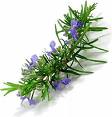
Rosemary (Rosmarinus officinalis) is a small evergreen shrub of the mint family. It doesn't tolerate cold and needs a sunny place sheltered from wind. It grows 1–2 m tall, with an upright, much-branched stem and narrow leaves that are silvery on top and covered in fine white hairs underneath. The leaves smell of camphor and taste bitter; drying makes them more bitter and less camphor-like. Small blue or violet flowers appear in clusters from March to May and again in September and October. It can be grown from seed in autumn or from cuttings in early spring.
Parts used
The flowering tops and leaves, gathered at flowering and dried in a shaded, airy place.
Constituents
The leaves contain 1–2% of a camphor-scented volatile oil, made up mainly of camphor, borneol, cineole and other terpenes, which is used in perfumes, cosmetics and scented soaps. They also contain tannins, bitter substances, triterpene acids, rosmarinic acid and resin.
Traditional uses
Rosemary is credited with antibacterial and antispasmodic effects, and is said to stimulate circulation and digestion and the flow of bile. Laboratory studies suggest its compounds have antioxidant and possible anti-cancer properties, but this hasn't been shown in people. It has been used traditionally for headache, circulation problems and period pain. It is a strong-smelling culinary herb, used in many cooked dishes with cured meats, fish, vegetables and meat.
- External: the leaves are used in baths, and the oil in ointments or massage, for rheumatism, back and nerve pain and joint pain.
- Internal: an infusion is used traditionally to strengthen the stomach and digestion, during recovery from illness, for tiredness and poor memory, and for period problems and indigestion. Make it with a teaspoon of leaves to a cup of boiling water, and drink one cup twice a day.
Caution: rosemary as a food seasoning is safe, but large amounts and the essential oil can cause seizures and should be avoided in epilepsy and in pregnancy. Rosemary doesn't treat heart disease, anaemia or epilepsy; these need a doctor. Don't use herbal preparations as a vaginal douche.
By Dr Elias Jabbour

Like

Love

Angry

Dislike